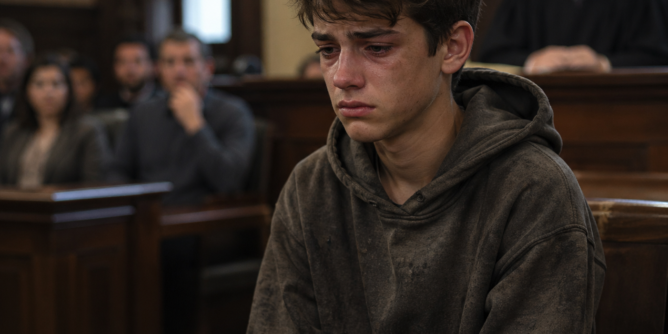
“The Boy Who Stole Bread… to Feed His Sister”
The courtroom was silent. Uncomfortably silent.
On the defendant’s bench sat a boy — thin, wearing an oversized, worn-out hoodie. His hands trembled slightly. He couldn’t have been more than fifteen.
The judge looked at him over his glasses.
“Name?”
“Amar…” the boy whispered.
The prosecutor stood up, flipping through his papers.
“The defendant was caught stealing from a local store. He attempted to take a loaf of bread and a can of food. This is not the first time he has been seen around the shop acting suspiciously.”
A quiet murmur spread through the courtroom. Some people shook their heads. Theft was theft.
The judge raised his hand.
“Amar… do you admit to the crime?”
The boy lowered his gaze to the floor.
“Yes…”
A short pause.
“Why did you do it?”
Silence.
The boy swallowed hard. His fingers clenched into a fist.
“I was hungry…”
The prosecutor immediately responded, his tone sharp.
“That is not an excuse. There are institutions, there are rules. If everyone started stealing because they were hungry—”
“Let him finish,” the judge interrupted, his voice calm but firm.
He turned back to the boy.
“Go on.”
Amar took a deep breath, as if gathering strength for something that hurt more than any punishment.
“It wasn’t… me who was hungry…”
The courtroom grew even quieter.
“My sister… she’s six… she’s sick… she hasn’t eaten for two days… she just kept crying…”
His voice broke.
“My mom works… but she’s been gone for a long time… she said she’d bring money… but she never came back…”
Tears rolled down his face, but he didn’t wipe them away.
“I told her I’d bring food… so she wouldn’t cry anymore…”
Someone in the audience let out a soft gasp.
The boy continued, almost whispering now:
“I took the bread… and that small can… I didn’t want anything else… just so she could eat…”
The courtroom fell into complete silence.
The prosecutor slowly lowered his papers. He had nothing left to say.
The judge sat still for a moment, looking at the boy. His eyes were different now — softer.
“Where is your sister now?”
“At home… alone… waiting for me…”
Those words hit harder than anything else.
The judge closed the file.
Everyone waited for the verdict.
But instead of speaking, the judge stood up.
Slowly, he stepped down from his bench and walked toward the boy.
People looked at each other, confused.
The judge knelt in front of him.
And without saying a word — he hugged him.
In that moment, something broke inside that room.
A woman in the audience began to cry. Then someone else.
The judge gently pulled back, placed his hand on the boy’s shoulder, and said:
“You are not guilty for trying to be a brother.”
He then turned to the courtroom.
“We are.”
Silence.
“A society that allows a child to steal just to feed another child… has no right to punish him.”
He looked at the prosecutor.
“The charges are dismissed.”
But he didn’t stop there.
“And one more thing…”
He faced everyone in the room.
“If we walk out of here today and forget this boy… then we are truly guilty.”
Several people immediately stood up.
“I’ll help,” one man said.
“So will I,” a woman added.
The courtroom became something else entirely.
Not a place of judgment.
But a place where, for the first time, someone chose to see.
And Amar…
He just stood there, confused, tears still in his eyes — but for the first time, not from fear.
From hope.
